Welcome to my
Portfolio
Here you can explore my work, what i do and how i bring my animations to life.
Over the Clouds
What began as a quick concept evolved into an absolute passion project. I knew I wanted to animate a dragon for my demo reel, but I wanted to break away from the typical “scary and dangerous” trope. Instead, I envisioned a gentle dragon and its little bird friend, joyfully flying over the clouds.
This concept allowed me to challenge myself technically by animating two completely different creatures in a single shot. Each character required a distinct sense of weight, pace, and scale, offering a unique opportunity to showcase versatility in movement and personality.
The core technical challenge of this shot was animating two creatures with vastly different scales, physics, and personalities in two continuous takes. The dragon required a sense of immense, fluid weight and slow, deliberate momentum, while the bird demanded quick, erratic, and lightweight movements.
The goal was to create a believable dynamic between them, showing how a massive creature can move with gentleness, and how a small creature can keep pace without being left behind.
I started by blocking out the primary poses to establish the rhythm of the flight. My priority was getting the “dance” right—ensuring the dragon’s wing beats and the bird’s flaps felt synchronized without being identical. I focused on the timing of their interaction, particularly moments where the bird would dart ahead or tuck in close to the dragon’s wing, ensuring the spatial relationship between them remained clear and readable.
Once the timing was locked, I moved into refining the secondary motion. For the dragon, I focused on the subtle sway of the body and the heavy, air-displacing movement of the wings. For the bird, I added rapid, snappy adjustments to its head and tail to convey its energetic personality. I paid close attention to the “follow-through” of their movements, ensuring that the dragon’s massive size felt grounded even while airborne.
To sell the scale and the environment, I collaborated with a colleague of mine, specialised in FX, to integrate a cloud simulation into the scene. We worked together to match the timing of the dragon’s flight with the density and movement of the clouds, ensuring that the dragon appeared to be pushing through them with realistic resistance. This collaboration allowed me to focus on the character performance while adding a vital layer of atmospheric depth and scale to the shot.
In the final stages, I smoothed out the curves and refined the transition between key actions. I paid special attention to the camera movement, ensuring it complemented the gentle mood of the piece rather than distracting from the characters.
Ice Skating
For this piece, I recreated the iconic 2018 Olympic performance of figure skaters Aljona Savchenko and Bruno Massot. My goal was to capture not just the technical precision of their gold-medal routine, but the emotional intensity and trust required for their high-risk lifts. This project allowed me to push my skills in fast-paced, synchronized character animation and complex partner dynamics.
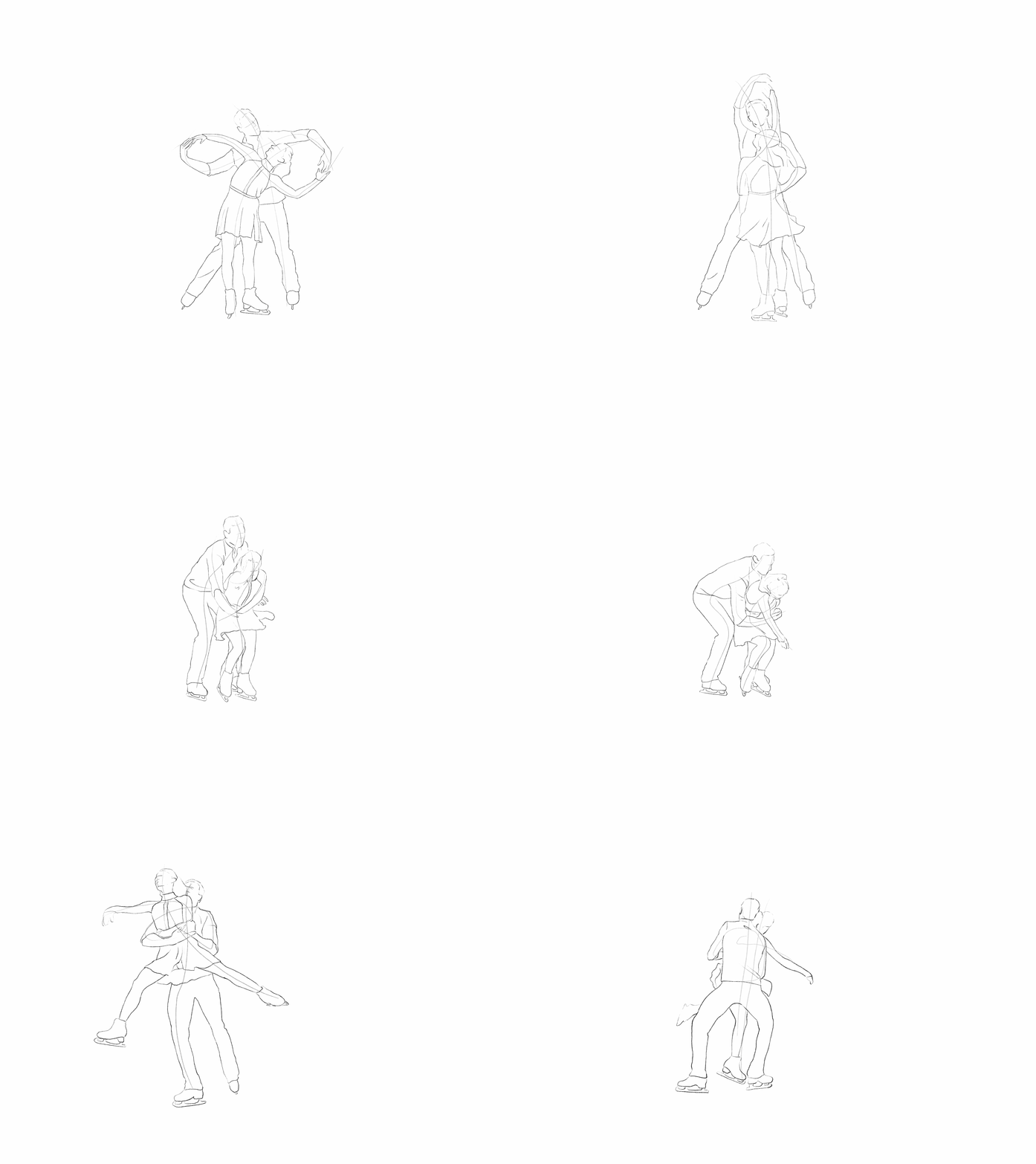
Figure skating presents a unique set of animation challenges: the characters are moving at high speeds on a low-friction surface, requiring constant micro-adjustments to maintain balance. Additionally, the “partner” aspect required me to animate two distinct body types (a tall, powerful male skater and a smaller, agile female skater) moving as a single, cohesive unit. The key was to make the difficult physics of their lifts look effortless and grounded.
I started by extensively studying frame-by-frame footage of the original performance to understand the timing of their jumps and lifts. I blocked out the primary poses, focusing on the center of gravity for both characters. For the lifts, I paid close attention to how Bruno’s core strength supported Aljona’s weight, ensuring that their connection points (hands, backs, and hips) remained stable and believable.
Once the blocking was set, I focused on the specific mechanics of skating. I added subtle sliding and gripping motions to their feet to sell the interaction with the ice. For the high-speed spins, I refined the body lines to ensure they remained tight and controlled, while adding slight “wobbles” or corrections to show the immense effort required to maintain balance.
A major focus was the relationship between the two characters. I animated their eye contact and subtle shifts in weight to convey the deep trust required for their routine. During the complex lifts, I ensured that Aljona’s body remained relaxed and fluid, while Bruno’s movements were strong and deliberate. This contrast helped highlight their distinct roles and the physical effort involved.
In the final stages, I smoothed out the curves and refined the timing of the transitions between elements. I paid special attention to the flow, adding secondary motion to enhance the sense of speed and momentum.
Funfact: My first ever animation was a traditional movement study of the same performance
For this shot, I animated two lionesses interacting in a dynamic scene. My primary goal was to capture their movements and emotions with maximum credibility. While focusing on realistic physical interaction, I also wanted to highlight their distinct personalities.
Balancing solid, believable mechanics with nuanced emotional expression was both a creative challenge and an opportunity to push my technical skills further. This project allowed me to explore how subtle shifts in movement can convey complex character dynamics.
Lionesses interacting
For this shot, I used a primary reference video to ground the animation in reality. This footage was essential for understanding the natural movements and emotional expressions of lions, allowing me to observe how they move, interact, and communicate through body language.
My research revealed the power of subtle movements. For instance, lions have a unique way of shifting their weight, using their tails, and expressing emotion through their eyes and posture. Capturing these nuances was key to making the animation feel not just realistic, but emotionally believable.
After finalizing the concept, I started by blocking out the basic movements and key poses. To ensure the collision felt physically grounded, I utilized ragdoll dynamics to simulate the initial impact and recoil of the lions. This allowed me to establish the correct timing and weight of the shot.
Once the rough blocking was in place, I moved into refining the poses and adding intricate details. This stage was crucial for bringing the lions to life, with a specific focus on weight shifts and subtle gestures that conveyed their distinct emotions and personalities.
In the final stages, I re-integrated ragdoll dynamics for muscle simulation. This added a vital layer of realism during the high-impact moments, ensuring the physical deformation of the characters matched the emotional intensity of the scene.
Playful Dragon
For this piece, I wanted to explore the intersection of technical rigging and comedic timing. I took a complex dragon rig—typically designed for majestic, heavy movements and applied the playful behavior of a puppy. The goal was to create a humorous contrast between the dragon’s intimidating size and its childlike curiosity, showcasing my ability to adapt animation principles to unexpected character personalities.
The main challenge was balancing the physicality of the rig with the behavior of the dog. A dragon rig usually has heavy, slow-moving limbs and a long tail. Translating “puppy energy”, which is fast, bouncy, and sometimes clumsy, required me to manipulate the rig’s constraints and curves to allow for exaggerated, snappy movements without breaking the character’s anatomical logic. I also had to ensure the dragon’s size still felt massive, even when it was jumping around like a small animal.
Before animating, I spent time exploring the rig’s controls to understand its limits. I identified which joints allowed for the necessary flexibility to mimic canine movement, such as the exaggerated tilt of the head and the wag of the tail. I adjusted the rig’s damping and constraints to allow for the “snappy” follow-through typical of dog animation, ensuring the dragon’s body felt loose and energetic rather than rigid.
I started by blocking out the primary actions: the playful pounces, and the curious head tilts. I focused heavily on timing and spacing to sell the puppy-like energy. The goal was to make every movement feel instinctive and uncoordinated, just like a real puppy.
Once the timing was locked, I added the intricate details of dog behavior. I focused on the micro-expressions: the eager tail wags, the playful bow (front legs down, rear up), and the exaggerated sniffing. I paid close attention to how the dragon’s weight shifted during these playful moments, ensuring that even when it was being silly, its massive size remained believable.
In the final stages, I smoothed out the curves and refined the transitions between actions. I added secondary motion to the dragon’s ears and tail to enhance the sense of joy and energy.